
Uncategorized • October 19, 2022

Getting to the Bottom of these Rollercoaster Rates

Why are mortgage rates going up and down? | Guaranteed Rate Affinity

Let’s start with a graph:

Chart, line chart Description automatically generated

Source: https://www.rate.com/mortgage-rates

This graph is almost exclusively peaks and valleys, no plateaus to be seen. Apologies if you strained your neck following along with all of the ups and downs.

So what are you looking at? This charts the average weekly mortgage rates for a 30-year fixed-rate mortgage from the first week of June to the second week of September of 2022. Rates were averaging 5.09% at the beginning of the graph and were 5.98% on the far right side. And in the middle, we see a lot of volatility.

Introducing rollercoaster rates

Rates are also going up and down on a daily basis, too. According to Mortgage News Daily, in the first week of September, rates went up 0.24% one day, down 0.21% the next, then back up 0.23% before two days of drops.

You see why we’ve been calling them roller coaster rates, right? Let’s look at what’s causing them to bounce around so much.

There are many different economic factors that will ultimately affect the mortgage rate you’ll get quoted from a loan officer. A lot of them are specific to you and your personal finances, like credit score and debt-to-income ratio. But the factors that most affect mortgage rates nationally reflect the greater economy. And as you may have heard, the economy is going through a weird phase right now.

Here are the five main factors that are affecting the mortgage rates you’re seeing.

Federal Reserve’s monetary policy

One of the most important factors in our economy is the monetary policy set by the Federal Reserve Bank, commonly referred to as the Fed. Their federal funds rate is a tool that they have to move the economy in the direction they want it to go. The federal funds rate is what commercial banks use to lend and borrow from each other.

That rate is not the same as the mortgage rate, but they are often mentioned together because mortgage rates often mimic the changes in the Fed’s rates. The rate impacts the long-term outlook of the bond market, which is a driver of mortgage rates (and we’ll talk about that later).

When the Fed raises rates, mortgage rates usually follow that upward trajectory. The Fed has been setting the federal funds rate higher and higher lately, which is why the more general trend of mortgage rates over the last year has been going higher and higher as well, despite frequent dips.

Wondering why the Fed has been moving their rate up? For one purpose—to fight inflation, which is one of the Fed’s main missions and the next rate-affecting factor that we’ll discuss.

Inflation

Inflation measures the declining value of currency throughout a period of time. It shows how the prices of the things we buy tend to go up over time due to lowering supply and increasing demand. When inflation gets higher, the purchasing power of the dollar goes down, meaning it costs more to buy something today than it did yesterday.

If you’ve heard any economic news over the last year or so, you know that inflation has been a concern for some time. As of this writing, the inflation rate was 8.3% higher than a year ago, which is down 0.1% from the previous month and half a percentage point from June. The Fed’s goal is to keep the rate of inflation around 2%. This higher rate of inflation is reflected in higher prices at the gas pump, for groceries and many other areas of the economy.

Inflation affects mortgage rates because lenders want to make sure that the money they earn on the interest of the loan is enough to overcome inflation. As inflation has gone up, lenders have responded with higher mortgage rates.

Bond market

When explaining the federal funds rate, we mentioned that that rate affects the bond market, but we didn’t mention how much of a role the bond market plays on mortgage rates. The performance of the bond market has been said to be the closest corollary to what’s going on with mortgage rates, with the 10-year Treasury Bond yield, also known as the 10-year T-note, known to follow the closest.

That’s because banks and investment firms package groups of mortgages into investment products that are called mortgage-backed securities. You may have heard that term as a contributing factor to the housing crash of 2008-2009, but don’t worry, these products have much more stringent guidelines, removing some of the risk that caused that great downturn.

Institutions purchase these mortgage-backed securities because they are a fairly consistent source of income, which are known as yields. When the bond market in general is performing well, mortgage-backed securities must keep up with their yields, so that could drive mortgage rates higher.

The bond markets have not been performing well over the first half of 2022. This has spooked investors and helped pull mortgage rates back down, even though rates have trended upward throughout 2022.

How fast the economy is growing

The health of the overall economy obviously plays a huge factor in mortgage rates. It is measured in many ways, and some of the most reliable are gross domestic product (GDP) and the employment rate. When the economy is performing well, more and more people are finding jobs and getting paid more. This in turn leads to more spending money on things, including on new homes. When more people have money to spend on a mortgage, lenders can set their interest rates higher.

However, the economy is confusing experts right now. Employment has been positive for a few months now, with numbers surging past where they were at the start of the pandemic. But there are also worries about a recession coming, fueled in part by the high inflation we’ve been seeing. Mortgage rates usually come down during recessions.

Just as the economy has been confusing experts, it also seems to be confusing mortgage rates right now. These contradictory economic datapoints seem to play a large part in today’s rollercoaster nature of rates.

Conditions in the housing market

Chalk up this last major factor to that tried-and-true economic principle of supply and demand. When demand is low, mortgage rates come down to try to entice more people to buy a home.

However, unusual and unique factors have rippled across the housing market since before the pandemic, and they continue to shake out now. It all started with a lack of inventory of homes for sale, which was actually an issue from at least 2019. When there aren’t enough homes for sale, housing prices go up as buyers compete against each other by raising what they’re willing to offer.

When the pandemic started, there was concern that the economy would suffer, so the Fed responded by lowering their rates to zero. This brought mortgage rates down to historic lows, reaching an average of 2.65% in January of 2021. These low rates, coupled with the greater focus on living spaces forced upon everyone by new WFH policies, brought buyers into the market with a force hardly ever seen before.

Consequences of keeping rates low

Despite the increase in demand, the Fed decided to leave interest rates low in order to prop up the economy. This led to lower and lower supply, as buyers took advantage of low rates to keep snapping up whatever homes they could find. Home prices kept going up as well.

Then the Fed decided it needed to start putting upward pressure on rates by bringing interest back into their federal funds rate, which pushed mortgage rates up. But home prices stayed at the same level they were at when mortgage rates were low, in fact prices kept going up even as mortgage rates were going up.

This led to a huge affordability problem.

The effect of affordability

The average price of a home has gone up almost $60,000 in a year, from $382,600 for the second quarter of 2021 to $440,300 in the second quarter of this year. In that time, the average mortgage rate in the last week of June went from 3.02% in 2021 to 5.7% in 2022.

These numbers are intended just as an example, but let’s say you could put down 20% on that average priced home in 2021 and have the same dollar amount for a down payment this year.  Just take a look at the difference in monthly costs for the same home, purchased at different times one year apart:

Year Home Price Mortgage Rate Down Payment PMI Monthly Payment (including taxes, insurance, and PMI)
June 2021 $382,600 3.02% $76,520 (20%) $0 $1,843
June 2022 $440,300 5.7% $76,520 (17.4%) $198 $2,829

This affordability issue, along with buyers frustrated by bidding wars and not finding a home they like due to the lack of options, has pushed potential buyers to the sidelines. Many are waiting for more favorable conditions before reentering the market. So, all of a sudden, demand is dropping, and that’s pushing lenders to tentatively lower rates to entice more buyers to get back into the market.

How these factors work together

To summarize, here are how those five economic factors are affecting the mortgage rates you’re seeing today:

Bringing rates up Pulling rates down Confusing rates
Fed monetary policy Bond market Economic growth
Inflation Housing market conditions

This push and pull effect likely accounts for much of the rollercoaster nature of mortgage rates. That’s why it’s best to keep an eye on rates, and be prepared to lock in a low rate the moment you see it.


<Original article here>

Uncategorized • October 19, 2022

Should You Still Buy a Home with the Latest News About Inflation?

Should You Still Buy a Home with the Latest News About Inflation?

While the Federal Reserve is working hard to bring down inflation, the latest data shows the inflation rate is still high, remaining around 8%. This news impacted the stock market and added fuel to the fire for conversations about a recession.

You’re likely feeling the impact in your day-to-day life as you watch the cost of goods and services climb. The pinch it’s creating on your wallet and the looming economic uncertainty may leave you wondering: “should I still buy a home right now?” If that question is top of mind for you, here’s what you need to know.

Homeownership Is Historically a Great Hedge Against Inflation

In an inflationary economy, prices rise across the board. Historically, homeownership is a great hedge against those rising costs because you can lock in what’s likely your largest monthly payment (your mortgage) for the duration of your loan. That helps stabilize some of your monthly expenses. James Royal, Senior Wealth Management Reporter at Bankrate, explains:

“A fixed-rate mortgage allows you to maintain the biggest portion of housing expenses at the same payment. Sure, property taxes will rise and other expenses may creep up, but your monthly housing payment remains the same.”

And with rents being as high as they are, the ability to stabilize your monthly payments and protect yourself from future rent hikes may be even more important. Lawrence Yun, Chief Economist at the National Association of Realtors (NAR), explains what happened to rents in the latest inflation report:

“Inflation refuses to budge. In September, consumer prices rose by 8.2%. Rents rose by 7.2%, the highest pace in 40 years.”

When you rent, your monthly payment is determined by your lease, which typically renews on an annual basis. With inflation high, your landlord may be more likely to increase your payments to offset the impact of inflation. That may be part of the reason why a survey from realtor.com shows 72% of landlords said they plan to raise the rent on one or more of their properties in the next year.

Becoming a homeowner, if you’re ready and able to do so, can provide lasting stability and a reliable shelter in times of economic uncertainty.

Bottom Line

The best hedge against inflation is a fixed housing cost. If you’re ready to learn more and start your journey to homeownership, connect with a real estate professional today.

<Original article may be found here>

Uncategorized • October 11, 2022

Saving for a Down Payment? Here’s What You Should Know

Saving for a Down Payment? Here’s What You Should Know.

As you set out to buy a home, saving for a down payment is likely top of mind. But you may still have questions about the process, including how much to save and where to start.

If that sounds like you, your down payment could be more in reach than you originally thought. Here’s why.

The 20% Down Payment Myth

If you believe you have to put 20% down on a home, you may have based your goal on a common misconception. Freddie Mac explains:

“. . . nearly a third of prospective homebuyers think they need a down payment of 20% or more to buy a home. This myth remains one of the largest perceived barriers to achieving homeownership.”

Unless it’s specified by your loan type or lender, it’s typically not required to put 20% down. According to the latest Profile of Home Buyers and Sellers from the National Association of Realtors (NAR), the median down payment hasn’t been over 20% since 2005. There are even loan types, like FHA loans, with down payments as low as 3.5%, as well as options like VA loans and USDA loans with no down payment requirements for qualified applicants.

This is good news for you because it means you could be closer to your homebuying dream than you realize. For more information, turn to a trusted lender.

Down Payment Assistance Programs Can Be a Game Changer

A professional will be able to show you other options that could help you get closer to your down payment goal. According to latest Homeownership Program Index from downpaymentresource.com, there are over 2,000 homebuyer assistance programs in the U.S., and the majority are intended to help with down payments.

A recent article explains why programs like these are helpful:

“These resources can immediately build your home buying power and help you take action sooner than you thought possible.”

And if you’re wondering if you have to be a first-time buyer to qualify for these programs, that’s not always the case. According to an article from downpaymentresource.com:

“It is a common misconception that homebuyer assistance is only available to first-time homebuyers, however, 38% of homebuyer assistance programs in Q1 2022 did not have a first-time homebuyer requirement.”

There are also location and profession-based programs you could qualify for as well.

Bottom Line

Saving for your down payment is an important first step on your homebuying journey. Connect with a local real estate advisor (like Rob Hurt!) and trusted lender today to begin exploring your options.

Original Blog Post Link here

Home Ownership • October 5, 2022

The Long Term Benefit of Home Ownership

The Long-Term Benefit of Homeownership

Today’s cooling housing market, the rise in mortgage rates, and mounting economic concerns have some people questioning: should I still buy a home this year? While it’s true this year has unique challenges for homebuyers, it’s important to factor the long-term benefits of homeownership into your decision.

Consider this: if you know people who bought a home 5, 10, or even 30 years ago, you’re probably going to have a hard time finding someone who regrets their decision. Why is that? The reason is tied to how you gain equity and wealth as home values grow with time.

The National Association of Realtors (NAR) explains:

“Home equity gains are built up through price appreciation and by paying off the mortgage through principal payments.”

Here’s a look at how just the home price appreciation piece can really add up over the years.

Home Price Growth Over Time

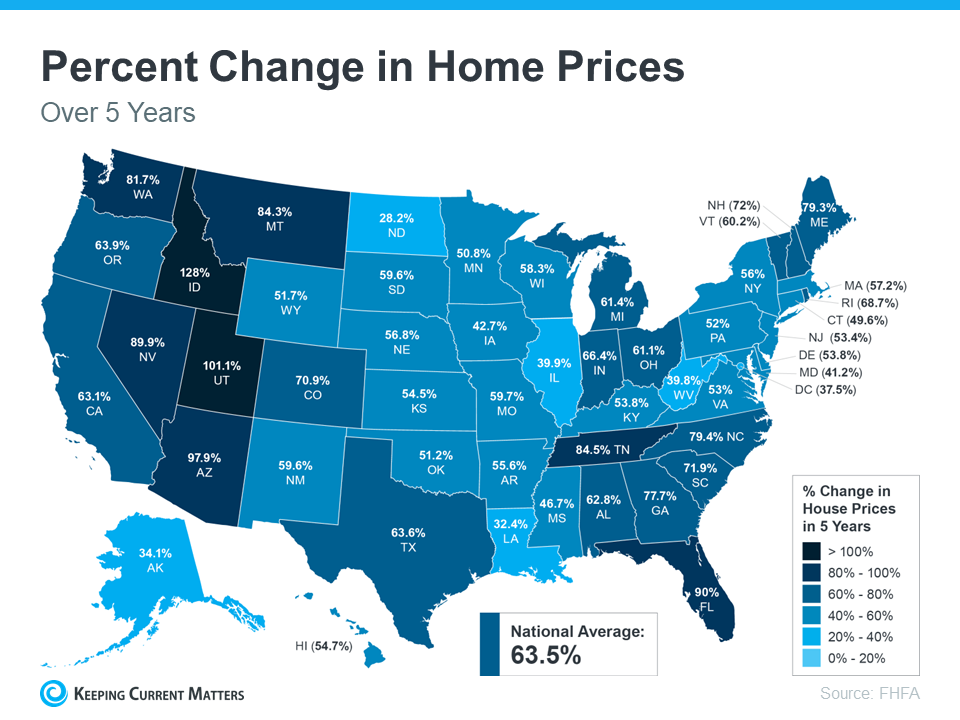
Even though home price appreciation has moderated this year, home values have still increased significantly in recent years. The map below uses data from the Federal Housing Finance Agency (FHFA) to show just how noteworthy those gains have been over the last five years.

The Long-Term Benefit of Homeownership | Keeping Current Matters

If you look at the percent change in home prices, you can see home prices grew on average by almost 64% nationwide over that period. 

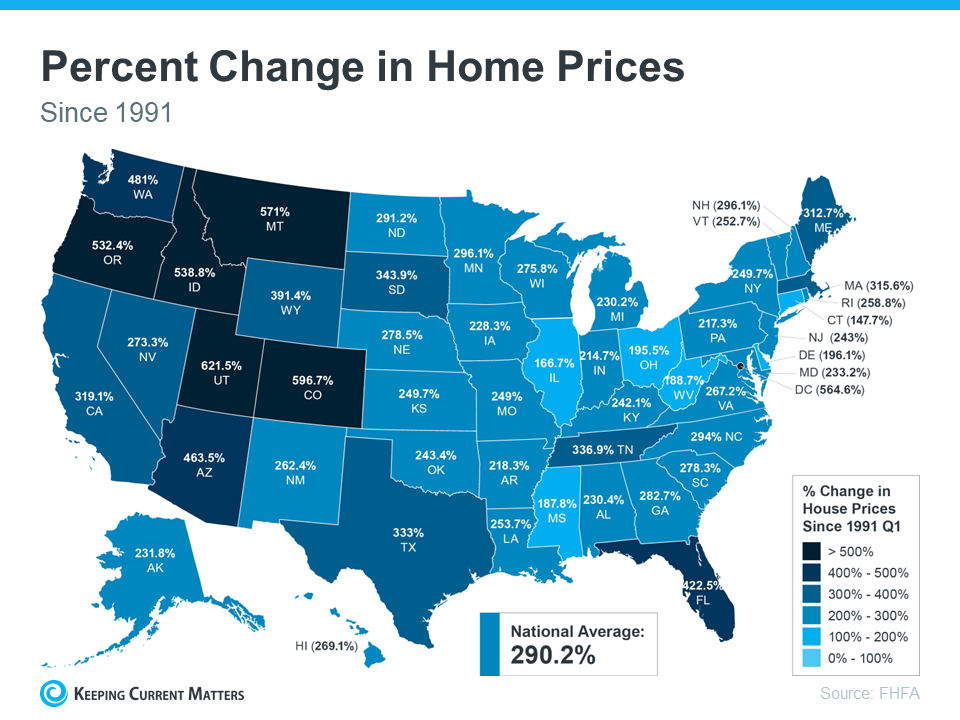
That means a home’s value can increase substantially in a short time. And if you expand that time frame even more, the benefit of homeownership and the drastic gains you stand to make become even clearer (see map below):

The Long-Term Benefit of Homeownership | Keeping Current Matters

The second map shows, nationwide, home prices appreciated by an average of over 290% over roughly a thirty-year span.

While home price growth varies by state and local area, the nationwide average tells you the typical homeowner who bought a house thirty years ago saw their home almost triple in value over that time. This is why homeowners who bought their homes years ago are still happy with their decision.

Even if home price appreciation eases as the market cools this year, experts say home prices are still expected to appreciate nationally in 2023. That means, in most markets, your home should grow in value over the next year even if the pace is slower than it was during the peak market frenzy when prices skyrocketed.

The alternative to buying a home is renting, and rental prices have been climbing for decades. So why rent and fight annual lease hikes for no long-term financial benefit? Instead, consider buying a home. It’s an investment in your future that could set you up for long-term gains.

Bottom Line

Don’t let the shifting market delay your dreams. Data shows home values typically appreciate over time, and that gives your net worth a nice boost. If you’re ready to start your journey to homeownership, reach out to a real estate professional today.

Link to original post:
https://www.keepingcurrentmatters.com/2022/10/05/the-long-term-benefit-of-homeownership/

Community • October 4, 2022

Fall Festivals Across Dallas/Ft. Worth

There’s no shortage of fall-inspired activities to do this season, so we’ve compiled a list of our favorite fall festivals across DFW.

September 22 was the official first day of fall, so everyone across Dallas-Fort Worth is in an autumn state of mind. There’s no shortage of fall-inspired activities to do this season, so we’ve compiled a list of our favorite fall festivals and events across Dallas-Fort Worth.

Whether you’re looking for something kid-friendly or spine-tingling, there’s a festival for everyone on our list:

AUTUMN AT THE ARBORETUM

This annual celebration at the Dallas Arboretum is a must-see on many people’s lists. Running now through October 31, find yourself transported into a fantasy world with this year’s theme: A Fall Fairy Tale. Prepare to exclaim “oh my gourd” as you walk through the elaborate displays that feature more than 100,000 pumpkins, gourds and squash as well as autumn flowers.

STOCKYARDS CHAMPIONSHIP RODEO

What would Fall in Texas be without a good old fashioned rodeo? Head over to the world-famous Stockyards in Fort Worth for one of their exciting Friday or Saturday night rodeo competitions. Events include tie-down, break away and team roping, as well as barrel racing and bull riding.

PUMPKIN NIGHTS

Needing your pumpkin fix this autumn? Open now through October 30, Pumpkin Nights at Howell Farms in Arlington has it all. Travel along a half-mile walking path featuring fantastical lands built using over 5,000 hand-carved real and artificial pumpkins. After the path, the seasonal celebration continues with entertainment and games in The Village.

STATE FAIR OF TEXAS

Running September 30 through October 23, everything is bigger at the State Fair of Texas! Ride the iconic ferris wheel, win an oversized stuffed animal, listen to live music and last but not least, eat delicious fried food. Try the award-winning Fried Charcuterie Board and Peanut Butter Paradise, or enjoy a classic Fletcher’s corn dog.

FRIGHT FEST – SIX FLAGS OVER TEXAS

If you’d rather partake in blood-curdling thrills, Six Flags Over Texas’s Fright Fest is right up your (dark) alley. Find yourself screaming both on and off the rides as you walk through themed scare zones and tackle the New Texas Giant or Titan at night. Continue the frights of Halloween at one of the many haunted houses across the metroplex like Fort Worth’s Cutting Edge, Plano’s Dark Hour or Waxahachie’s Screams.

DENTON ARTS AND JAZZ FESTIVAL

As one of the largest tourist attractions in North Texas, the Denton Arts and Jazz Festival on October 1-3 provides the finest in entertainment and art across the Dallas/Fort Worth Metroplex.Enjoy jazz, blues, and cross-cultural music from six stages, a delicious variety of food, breathtaking art and kids activities – making this event perfect for the whole family.

MIDLOTHIAN VILLAGE DAY FESTIVAL

Head to Midlothian on October 15 for the 40th Annual Midlothian Village Day Festival. This community-centered event is filled with fun activities including crafts, games, inflatables, entertainment, food vendors and a raffle. There is no cost for admission, and this year features a parade so don’t forget to bring a chair.

MCKINNEY WINE AND MUSIC FESTIVAL

Nothing beats an afternoon of wine tasting and live music! On Saturday, October 15, the 6th Annual McKinney Wine and Music Festival features 30 award-winning wineries, live music all day and a huge variety of local vendors.

WATER LANTERN FESTIVAL

If you’re looking for a unique fall experience this October, head over to Fort Worth’s Panther Island Pavilion on Saturday, October 22 for the Water Lantern Festival. Enjoy food trucks, kids activities and live music as you create your unique lantern. At sunset, watch as thousands of lanterns are released onto the lake carrying messages of hope, happiness and healing.

ENNIS AUTUMN DAZE

Looking for some fall fun for the whole family? Head down to the 20th annual Ennis Autumn Daze in historic downtown Ennis on October 28-30. Featuring live music from Pat Green and Gary P. Nunn, carnival rides, haymaze, pumpkin patch, cornhole tournament, professional pumpkin carvers, food, shopping vendors and more, you won’t want to miss out on this annual event.

PUMPKIN PATCHES

Whether you want to pick out pumpkins to carve or take family pictures, here’s our list of favorite pumpkin patches:

  • Aubrey – Team Family Farms
  • Cleburne – Mainstay Farm Park Pumpkin Days
  • Decatur – Black Creek Farm & Pumpkin Patch
  • Flower Mound – Flower Mound Pumpkin Patch
  • Frisco – Pumpkins on the Prairie
  • Grapevine – Hall’s Pumpkin Farm
  • McKinney – Storybook Ranch
  • Midlothian – Shadow Creek Pumpkin Farm
  • Rockwall – Blase Family Farm
Uncategorized • October 4, 2022

The Cost of Waiting for Mortgage Rates To Go Down

The Cost of Waiting for Mortgage Rates To Go Down

Mortgage rates have increased significantly in recent weeks. And that may mean you have questions about what this means for you if you’re planning to buy a home. Here’s some information that can help you make an informed decision when you set your homebuying plans.

The Impact of Rising Mortgage Rates

As mortgage rates rise, they impact your purchasing power by raising the cost of buying a home and limiting how much you can comfortably afford. Here’s how it works.

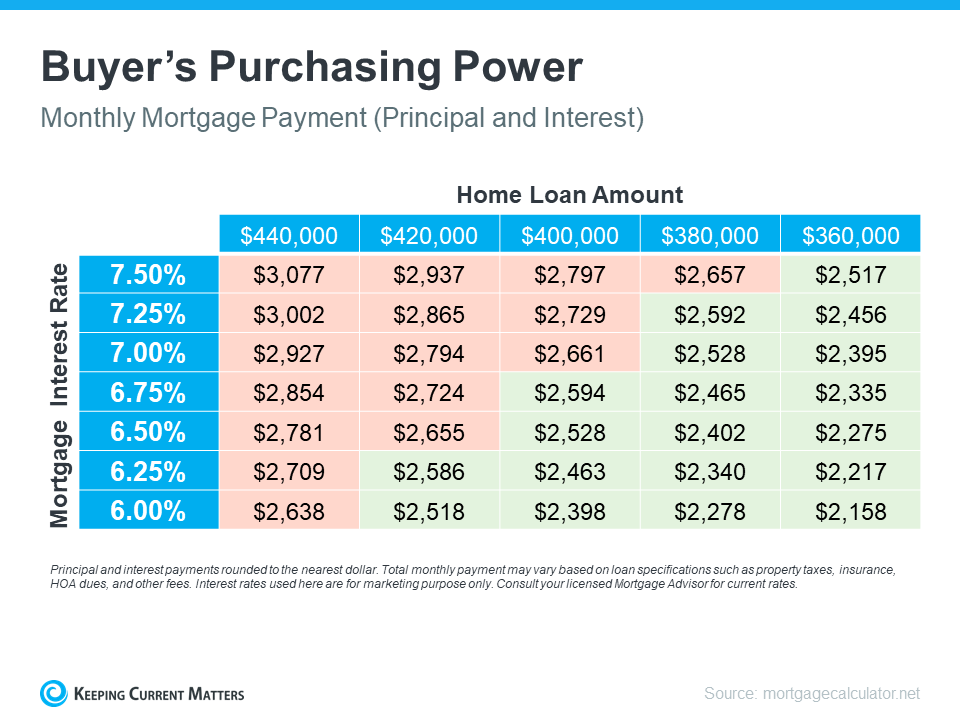
Let’s assume you want to buy a $400,000 home (the median-priced home according to the National Association of Realtors is $389,500). If you’re trying to shop at that price point and keep your monthly payment about $2,500-2,600 or below, here’s how your purchasing power can change as mortgage rates climb (see chart below). The red shows payments above that threshold and the green indicates a payment within your target range.

The Cost of Waiting for Mortgage Rates To Go Down | Keeping Current Matters

As the chart shows, as rates go up, the amount you can afford to borrow decreases and that may mean you have to look at homes at a different price point. That’s why it’s important to work with a real estate advisor to understand how mortgage rates impact your monthly mortgage payment at various home loan amounts.

Are Mortgage Rates Going To Go Down?

The rise in mortgage rates and the resulting decrease in purchasing power may leave you wondering if you should wait for rates to go down before making your purchase. Realtor.com says this about where rates could go from here:

“Many homebuyers likely winced . . . upon hearing that the Federal Reserve yet again boosted its short-term interest rates by three-quarters of a percentage point—a move that’s pushing mortgage rates through the roof. And the already high rates are just going to get higher.”

So, if you’re waiting for mortgage rates to drop, you may be waiting for a while as the Federal Reserve works to get inflation under control.

And if you’re considering renting as your alternative while you wait it out, remember that’s going to get more expensive with time too. As Nadia Evangelou, Senior Economist and Director of Forecasting at the National Association of Realtors (NAR), says:

“There is no doubt that these higher rates hurt housing affordability. Nevertheless, apart from borrowing costs, rents additionally rose at their highest pace in nearly four decades.”

Basically, it is true that it costs more to buy a home today than it did last year, but the same is true for renting. This means, either way, you’re going to be paying more. The difference is, with homeownership, you’re also gaining equity over time which will help grow your net worth. The question now becomes: what makes more sense for you?

Bottom Line

Each person’s situation is unique. To make the best decision for you, partner with a real estate advisor to explore your options.